
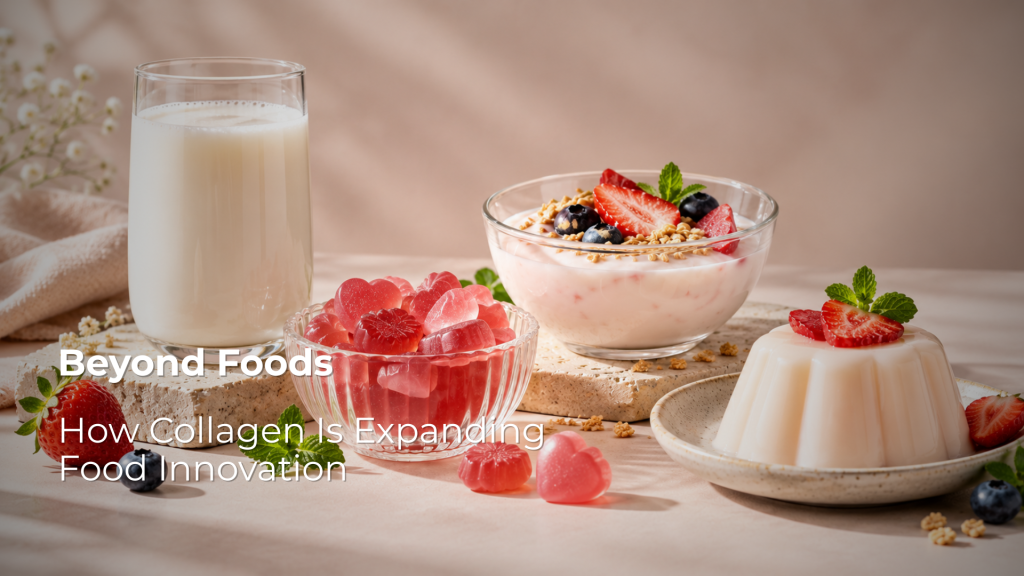
For many years, collagen has been strongly associated with beauty products and dietary supplements, particularly those positioned around skin health, healthy aging, hair, nails, and joints. Today, however, its role in food and beverage is becoming much broader.
Collagen is increasingly being incorporated into nutritional beverages, snacks, desserts, confectionery, and other functional food formats. This reflects a larger shift in consumer behavior: wellness is becoming part of everyday eating and drinking habits rather than being limited to supplements.
For food manufacturers, this creates an opportunity to develop familiar products with added functionality. A dessert can offer a functional proposition while remaining enjoyable. Confectionery can combine indulgence with nutritional value. Beverages can deliver functionality in a convenient format that fits naturally into consumers’ routines.
However, adding collagen to a formulation is not simply about achieving a nutritional target. The ingredient also needs to work within the final product. Taste, texture, solubility, stability, dosage, processing conditions, and compatibility with other ingredients all need to be considered.
This is where the source of collagen becomes an important consideration. Fish-derived collagen and bovine collagen can provide different options for product developers depending on the desired application, consumer positioning, and formulation requirements. Recent research also highlights that collagen from different sources can have distinct sensory characteristics and functional properties.
Fish collagen, for example, is increasingly explored as an alternative source for functional foods and beverages, while bovine collagen remains an established option across various food applications. The choice should therefore be driven not only by the source itself, but by how well the ingredient performs in the intended product.
Looking toward 2026–2027, the opportunity for collagen lies not only in its traditional beauty positioning, but in how effectively it can become part of broader food and beverage concepts. The question is shifting from “What can collagen do?” to “What kind of product experience can we create with collagen?”
The future of functional food will depend on integrating functionality with taste, texture, convenience, and consumer relevance. Collagen is therefore becoming more than a beauty ingredient, it is increasingly part of a broader approach to food innovation.
GLK Perspective
At GLK, we provide fish collagen and bovine collagen solutions for food manufacturers exploring functional food, beverage, dessert, and confectionery applications. As a House of Specialty Ingredients & Solutions, we believe the right ingredient starts with understanding the application, connecting ingredient characteristics with product performance and evolving consumer needs.